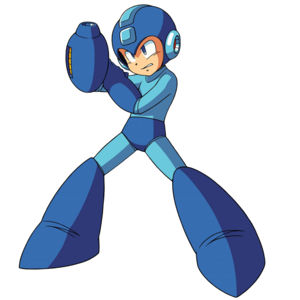
Though it’s been out for a while, I only recently downloaded Capcom’s Mega Man 9, an anomaly among other recent game releases. It is the latest offering in the classic Mega Man series, whose heyday was in the late 80s and early 90s.
But while other sequels of cherished franchises do everything in their power to take advantage of the newest technology available, going places that the old games weren’t capable of going to, Mega Man 9 does the opposite.
Instead of targeting a new generation of players, Capcom sought now adult players of the old games by painstakingly emulating every graphical restriction, sound channel limit, and level design choice as it would have occurred on the original Nintendo Entertainment System, and the result is an entirely new game that appears as though it belongs in the 1980s.
The magic of the title, therefore, is not what is new and fresh, but rather a walk down memory lane for those of us who struggled alongside Mega Man during a more innocent time in our lives.
Fans of the Mega Man series, including myself, have felt bright smiles appear on our faces as the game transports us back to our childhood. Capcom did everything it could to make sure that the game was a faithful sequel, so that if you could go back in time and release it amidst the other Mega Man games, no one would notice anything strange.
But there is something fascinating about a game company releasing a title made for a different time; it provides a snapshot of how games as a form of entertainment have changed through the last 20 years.
Obviously, changes in graphics and sound technology have come about, and these are readily identifiable. Latent changes and trends in our industry, however, lie revealed in the design choices of the game.
Mega Man 9 is a kind of time capsule, a blast from the past, and in playing it, you can’t help but feel that even beyond the large pixels, bleeps, and bloops, the game layout and design itself result in a gameplay experience that is almost extinct.
Unreasonably Difficult And The Risk Of Time
When picking up Mega Man 9, most players notice something almost immediately — the game is unreasonably difficult.
The feeling that many players and reviewers have expressed, that the game is too hard, comes from the lens of our current industry. As interactive entertainment grew and expanded, our industry has become a place where games are targeted at the mass market, tuned for a perfect challenge ramp, and sculpted to provide the most entertaining experience possible.
Mega Man 9 refrains from this philosophy; the game is notoriously unforgiving. Each stage consists of only two save points, a mid point and right before the boss. Thus, if you happen to die when you are 49 percent of the way through the stage, which is a 10 minute experience at minimum, then you are yanked all the way back to the beginning of the level.
This is unheard of among games nowadays. No developer with sales in mind would punish Mega Man so ruthlessly, as players would simply decide the game wasn’t worth their time, turn off the system, and go on with their lives.
To entice the players of today — who are short on time and have even shorter attention spans — positive feedback and progress must be much more frequently communicated than once every few hours.
Recently, after successfully jumping and shooting my way through one of the stages over the course of a full 60 minutes, I arrived at the boss, the final enemy. On my way to his room, I managed to lose all of my extra lives, and so as I fought him, I knew that it was all on the line.
For about 30 seconds or so, the fight raged on; I was doing my best to recognize his pattern and avoid his attacks while sneaking in a few shots of my own. It seemed like a normal gaming experience until I noticed something odd — my heart was pounding almost right out of my chest. My hands were shaking, my palms were sweaty, and I had even stifled my breath.
Why was this happening? Why was I, an adult far removed from my childhood world, so nervous and invested in this game? The reason was that if I was unsuccessful in the battle, if this robot master defeated Mega Man, then I was going to have to replay the entire stage all over again.
An entire hour of play, try after try after try, would be flushed down the drain. Unless I came away with a victory, I might as well have not played the game at all, it seemed. But if I did win, then I was victorious! All of my work would be rewarded, and I would not have to replay the stage. It would be done, completed, defeated by Mega Man.
With such high stakes, the battle was as epic as ever. Even though I was only watching tiny pixels dance around on my television, I was as emotional as when my high school tennis team was playing in the district finals.
Within another 30 seconds, I fired a final shot, and the boss was defeated. I let out a yell as a wave of triumph washed over me, and I slumped back into my futon, a silly grin plastered on my face.
What struck me was that this was a collection of sensations that I hadn’t felt since I was a child, a realization which made me think how much games have changed. By being bold enough to make a game of such intensity, the developers of Mega Man 9 tapped into an emotional reservoir that allowed for such memorable gameplay.
Since a loss in the game held the real life consequence of requiring me to play through the stage again, our goals became one. Mega Man’s potential death carried with it not just a fictional weight, but a real cost to my personal life, and thus a victory carried with it a true emotional reward. It was a temporary marriage of the world of Mega Man and reality.
However, this level of challenge comes with a price. Because the learning curve is so steep, those who aren’t willing to risk the time, perhaps the many who don’t have a childhood attachment to Mega Man, miss out on the experience.
By choosing to make the game so difficult, the developers rewarded a few but alienated many. This is the reason that Mega Man 9 stands in such stark contrast to the games of today.
Emotional investment or not, what matters to a for-profit game company is the number of SKUs a title has sold, and most players simply will not survive without more frequent sips of positive feedback and some signs marked “well done”.
A Lesson In Persistence
Mega Man 9’s difficulty and subsequent capability for emotional investment brings with it another broader life lesson. At the time of this article’s writing, I’ve beaten about six of the eight robot masters, over the course of a month.
In half-hour increments, I suspect I’ve invested about six or seven hours into the game. But today, when I went to go load my game, I glanced at the “playtime elapsed” statistic, and was puzzled. Instead of six or seven hours, the clock read only 55 minutes, just under an hour.
At first, I was perplexed by this, since I had surely played the game much more than that. But I quickly understood what was going on. This playtime statistic didn’t represent all of the times I’d played the game, it only represented the time accumulated after I saved the game. And unless I had completed a stage, there was no reason to save the game.
All of those hours I had spent playing a stage three quarters of the way through before quitting were not recorded. As far as the game was concerned, I had made no progress.
Since the game is incredibly hard, you may play the game for hours before you receive the positive feedback of completing a stage. So what’s happening during all of those hours?
If the game thought it only took me an hour to run through six stages, what was going on during the other five hours I had spent getting 90 percent of the way through each stage before colliding with a spike? Were they simply a waste of time? If I played through to a robot master and was defeated, was my struggle for naught?

The answer to this question depends on the outlook of the player and how they choose to assess the “Game Over” screen. Stanford Professor Carol Dweck researched the mindsets of children and adults alike for decades, and her studies resulted in a dichotomy of two distinct worldviews.
The first and more common is the Fixed Mentality, the belief that one’s skills and lot in life are constant and unchanging. People who subscribe to this mentality are more likely to give up in the face of adversity (or in the case of Mega Man, the inability to complete a stage). They see their efforts that end in Mega Man’s death as fruitless, and become frustrated by the game.
The second mindset is Growth Mentality, which is when a person believes that their skills are constantly improving as a result of their actions. When they see a challenge, they persist, because they believe that through effort, they will eventually master it. When they are presented with the “Game Over” screen, they don’t see a waste of time, instead they reflect on the learning experience that their previous playthrough has given them.
“Experience is what you get when you don’t get what you want,” goes the old adage. In Mega Man 9, the player obviously wants to clear the stage. However, if the player goes through the stage and then dies right before completing it, the Growth Mindset dictates that they have not truly wasted their time. They learned a great deal on their journey, and this knowledge will serve them better next time.
They learned that it takes three shots to defeat the springy robots. They learned that there are spikes coming up at the next screen, and they better move left if they want to survive. They learned that it’s best to run full speed through the deluge of bullets instead of trying to tiptoe.
All of this information, gained through painful trial and error, is valuable. While some players may view death as a failure, others will watch Mega Man explode into a million bits and say, “Well, that’s okay. I know not to do that next time.”
Thus, almost every time the player dies, they are actually making progress. Their reflexes are getting faster, they’re learning and memorizing the stage, and they’re finding the best route through it.
Internal vs. External Feedback
The difference between Mega Man 9 and other games today is the pacing of the positive feedback that the game imparts on the player, and this pacing decision affects where the feedback originates from. If you listen to the death sound effect that plays every time Mega Man runs out of health, the game is communicating that the player failed.
And indeed, according to the bits and bytes stored on the hard drive, the player made no progress. Other present day games would not dare be so ruthless. They would encourage the player, either by stamping that they played the game that day at all (as in Brain Age), charting their progress against themselves instead of the game (Wii Sports), or allowing them to save more often, breaking their triumphs into smaller increments (the Half Life series).
But interestingly, the difficulty of Mega Man 9 demands that the player keep track of their progress themselves.
In order for a player to be successful at any challenge that gives little positive feedback, one of two items is required. The first is readily available to many children but not many adults — the luxury of time.
When players enjoyed the old Mega Man games, the fact that they were so difficult was not a problem, because we could wake up, play the game until school, come home from school, and play until bedtime. Day in and day out, we knew the game would be beaten eventually.
However, when an abundance of time is not available, then another attribute must be present for a person to be successful and enjoy the journey — player driven feedback, which is born out of a player’s Growth Mindset.
People of all ages become frustrated when they sense they are making no progress. But if they believe that progress is being made internally, that they are learning from their failures, then they encourage themselves to continue pressing on.
After playing the game, I came to develop this outlook towards it, and it made the game very enjoyable to me, even though I am not one who enjoys difficult games in my adult life. I would often go over to other friends’ homes and notice that they also downloaded Mega Man 9, which I would pick up and play.
It didn’t matter that my save file wasn’t on their console, because the experience I was gaining wasn’t stored on their hard disk, it was stored within me. As I learned to navigate Galaxy Man’s stage on my friend’s Xbox, I didn’t view it as a loss that I couldn’t save my progress, because the next time I picked up the game on my Wii, that experience would show through, as I would go even further than before.
When I played through Splash Woman’s stage before going to sleep, only to die right at the end and be presented with a “Game Over” screen, I wasn’t discouraged, because I knew that the next time I played her stage I would likely win. By believing that I was making progress within myself, despite the absence of positive feedback from the game, my eventual victory was assured.
The Difficulty Curve Of Life
The difficulty curves in real life are more similar to Mega Man 9 than today’s games, and to be successful, they also require internal positive feedback. In reality, achievement is not recognized until a massive performance has been completed.
Students don’t receive points for memorizing a single vocabulary word; they only receive a grade that assesses their familiarity with a collection of 100 words. Tennis players don’t hear a pleasant “Nice shot!” after they hit a good forehand at tennis practice, they only are congratulated after winning an entire match. Employees don’t receive a smiley face sticker every time they contribute to their project; they only receive a single pat on the back from their yearly performance evaluations.
In the same way, players of Mega Man 9 aren’t rewarded along the way, but only after completing an entire stage, the result of hours of struggle. To reach that accomplishment, the positive feedback must be generated by the player, not the environment.
Of course, being successful in Mega Man 9 does not necessarily translate to success in life. But the lessons from the game design of years past sing the same tune. The lack of well tuned positive feedback in a game environment evokes a different play experience with different requirements for success.
Learning to create positive feedback and encouragement from yourself, and deciding to view every failure as a learning opportunity applies to both Dr. Wily’s fortress as well as one’s real life career.
It may take me until New Years, but I’m coming for you, Wily!